
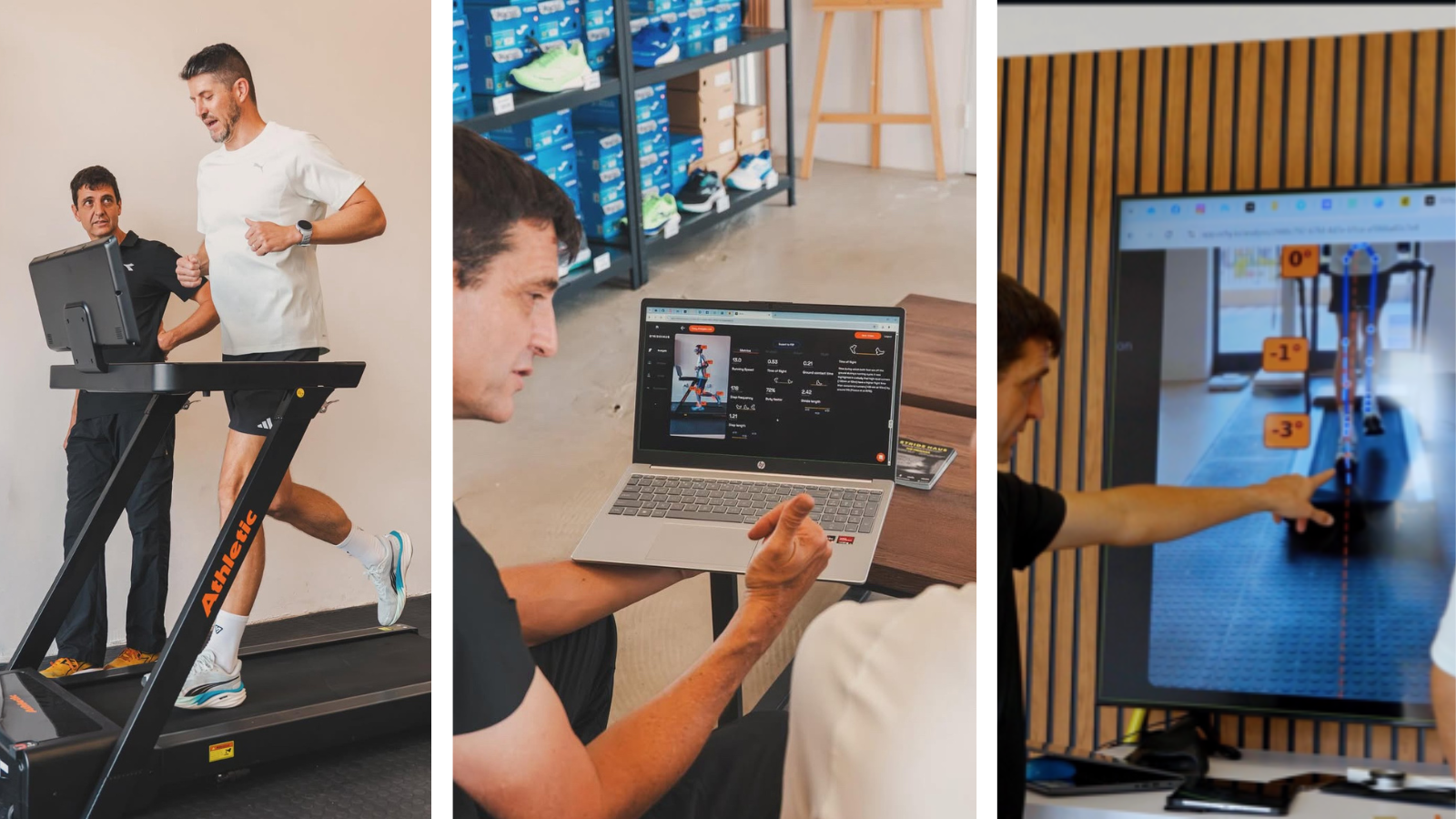
Understanding exactly when your foot hits the ground and when it leaves it is one of the most fundamental parts of accurate gait analysis. These moments—known as foot landing (initial contact) and toe-off—influence cadence, stride mechanics, loading patterns, asymmetries, and ultimately how precisely we can guide your running technique and injury-prevention strategy.
As part of our continuous effort to advance biomechanical accuracy, we recently tested several new algorithms for detecting these key events in treadmill side-view videos.
Think of it as teaching our system to find the exact video frame where your foot touches down or lifts off—with near-lab precision.
What We Tested
Our team compared multiple detection methods on the same dataset of treadmill running videos. Each method was evaluated on:
- Accuracy: Does it correctly identify the true foot landing or toe-off moment?
- Precision: How close is the detection to the exact video frame?
- Robustness: Does it hold up across different speeds, foot strikes, and runner profiles?
- Error Rate: How often does it miss an event or falsely detect one?
📊 What We Found
1. Detecting Foot Landing (Initial Contact)
Two new methods clearly outperformed our current system.
• Top-performing method: 99.6% accuracy
This method almost never misses a landing event and is off by less than one video frame—a level of precision previously only achievable in lab-grade motion capture systems.
• Second-best method: 97.4% accuracy
This approach also delivered exceptional results, generating only 2 false positives across the entire test. It’s highly reliable and stable across different running patterns.
Together, these two methods performed 2–3× better than our current production method.
2. Detecting Toe-Off (Foot Leaving the Ground)
Toe-off is notoriously harder to detect, even in controlled biomechanics labs. But one new method emerged as a clear standout:
• Best toe-off method: 92.7% accuracy
This method significantly outperformed our existing approach and demonstrated excellent consistency across different speeds and foot-strike patterns.
Just like with foot landing, the new approach reduced errors by a large margin and delivered much tighter frame-accuracy.
💡 Why This Matters
These improvements aren’t just academic—they directly translate into a better experience for runners and more trustworthy coaching insights.
What the new methods bring:
- 2–3× more accurate detection compared to our current pipeline
- Up to 85% fewer errors, making analyses more stable and reliable
- Better precision for metrics like cadence, contact time, stride symmetry, ground reaction patterns, and loading phases
- Improved robustness across running styles, speeds, and shoes
- Ready for real-world testing in the Ochy app
For runners, this means more reliable data, more actionable insights, and an analysis that better reflects the reality of your running form.
For coaches and medical professionals, it increases the trust and repeatability of our event-based metrics—enabling clearer progress tracking and more accurate decision-making.
What’s Next
These top-performing methods are now moving into user testing as part of our ongoing accuracy upgrade roadmap. Once validated on large-scale, real-world footage (smartphones, angles, lighting conditions), they’ll be deployed into Ochy’s live analysis engine.
This is just one step in our commitment to continuously push the boundaries of smartphone-based biomechanics—bringing lab-grade accuracy to every runner, everywhere.